


So here's a question I get a lot from business owners on the Central Coast: "Why does that contractor two miles away keep showing up before me on Google?"
The short answer? Because he's two miles closer to whoever's searching.
I know. It sounds unfair. You've got better reviews, a nicer website, and you've been in business longer. But Google doesn't care about fairness. Google cares about giving searchers what they want. And most of the time, what they want is something nearby.
Let me break down what actually matters for local search in 2024, and more importantly, what you can actually do about it.
The Numbers: Why Location Dominates
Let's start with the uncomfortable truth.
A recent study analyzing over 3,000 businesses found that proximity accounts for about 55% of what determines your local ranking. More than half. Everything else, reviews, your website, your business category, all of that fights over the remaining 45%.
Here's why this matters: 46% of all Google searches have local intent. People searching "plumber" aren't looking for plumbing tips. They're looking for a plumber near them, right now.
80% of U.S. consumers search for local businesses weekly. A third of them search daily. That's a lot of potential customers, and Google is deciding who they see first based largely on who's closest.

What Google Actually Says
Google's official documentation says local rankings are based on three things: relevance, distance, and prominence.
Relevance is how well your business matches what someone searched for. If you're a pizza place and someone searches "pizza," that's a match.
Distance is how far you are from wherever Google thinks the searcher is. This is the proximity factor, and it's the biggest one.
Prominence is how well-known your business is. This includes reviews, links to your website, how complete your Google Business Profile is, and other signals that tell Google "this is a real, established business."
Notice what's not on that list? Your website’s keywords. Your domain age. Whether you paid for premium hosting. None of that matters as much as where you’re physically located.
The Good News: Reviews Move the Needle
Here's where it gets interesting. That same study found something encouraging: for the top 10 results, review count jumps to 26% of ranking influence. Review relevance (what people actually say in their reviews) accounts for another 23%.
Translation: proximity gets you in the game. Reviews help you win it.
83% of consumers use Google to find local business reviews. They're not just looking at star ratings, they're reading what people write.
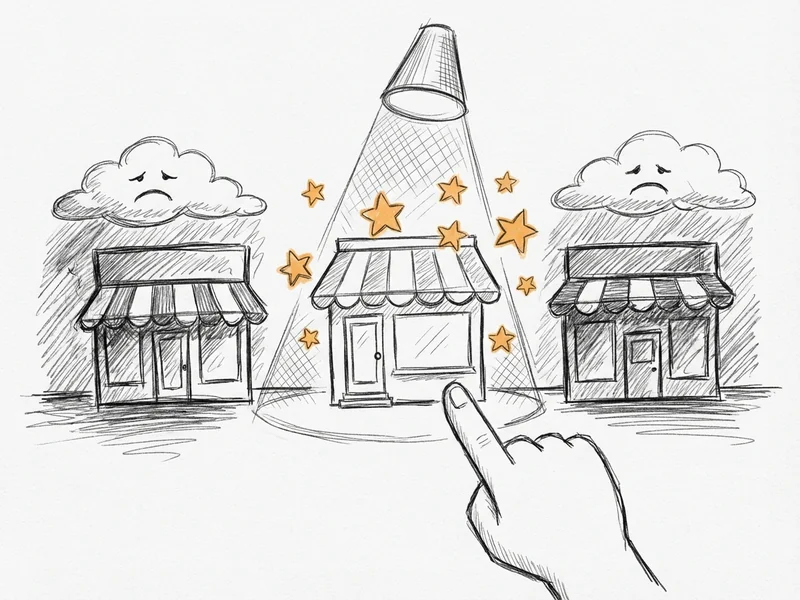
42% of local searchers click on the map pack results, those three businesses that show up with the map at the top of search results. If you're not in that top three, you're invisible to nearly half your potential customers.
Three Things You Can Actually Control
You can't pick up your business and move it closer to every potential customer. But you can control these three things:
1. Get More Reviews (And Respond to All of Them)
88% of consumers say they'd use a business that responds to both positive and negative reviews. Only 47% would consider a business that doesn't respond at all.
That's a massive gap. Almost double the consideration rate just for replying to reviews.
The strategy is simple:
- Ask happy customers for reviews. Make it easy, send them a direct link.
- Respond to every review within 24-48 hours.
- For negative reviews, acknowledge the problem and offer to make it right. Future customers are watching.
20% of consumers want to see reviews from the last two weeks. Recency matters. A steady stream of new reviews beats a pile of old ones.
2. Keep Your Business Information Consistent
62% of consumers would avoid using a business if they found incorrect information online. Wrong hours, old phone number, different address on different sites, all of these kill trust.
Your name, address, and phone number (what SEO people call "NAP") need to be exactly the same everywhere:
- Google Business Profile
- Your website
- Yelp, Facebook, Apple Maps
- Any directory that lists your business
Check all of these at least once a quarter. I've seen businesses lose customers because their Google hours said "closed" on a Saturday when they were actually open.
3. Fill Out Your Google Business Profile Completely
Google gives you lots of fields to fill out. Most businesses skip half of them. Don't be that business.
- Business category: Pick the most specific one that applies. "Plumber" is better than "Home Services."
- Services: List every service you offer. This helps you show up for specific searches.
- Photos: Real photos of your work, your team, your location. Not stock images.
- Business description: Write it for humans, not search engines. What do you do? Who do you help?
- Hours: Keep them updated. Add special hours for holidays.
- Q&A section: Answer common questions yourself before someone else does.
74% of consumers check at least two review platforms when researching a business. Your Google profile is usually the first stop, but it won’t be the last. Make sure it tells a complete story.
(If you were using Google’s free Business Profile website—the ones ending in business.site—those shut down in 2024. You’ll need a real website now.)

What About Keywords and Website SEO?
Your website still matters, just not as much as you might think for local search. Here's the hierarchy:
- Proximity (can't control)
- Reviews (quantity, quality, recency)
- Google Business Profile completeness
- Website authority and relevance
- Citations (directory listings)
Your website helps with that "prominence" factor Google mentioned. A website that clearly describes your services, mentions your service area, and has other local sites linking to it tells Google you're legitimate.
But here's the reality: a business with a mediocre website and 50 great reviews will usually outrank a business with a beautiful website and 5 reviews.
The SLO County Angle
Here's something specific to the Central Coast: we're a collection of small towns spread out along the coast and into the valley. Paso Robles, San Luis Obispo, Arroyo Grande, Morro Bay, these all have distinct search patterns.
If you're a contractor in Templeton, you're not competing with contractors in Pismo Beach. You're competing with other contractors in Templeton and the northern part of the county. Google knows the difference.
This means:
- Your address matters. If you serve multiple areas, consider whether a different physical location would help.
- Service area settings in your Google Business Profile matter. Be specific about which cities you actually serve.
- Reviews mentioning specific locations ("Great work on our Cayucos beach house") help Google understand your service area.
The Bottom Line
Local SEO isn't magic. It's math. Proximity is the biggest factor, and you can't change where you are. But reviews, profile completeness, and consistent information are all within your control, and they make a real difference.
Start with reviews. Ask every happy customer. Respond to every review you get. Fill out every field in your Google Business Profile. Check your information across different platforms.
Do those three things consistently, and you'll be ahead of 80% of local businesses who aren't paying attention.
What YouGrow Does Differently
Every YouGrow website is built with local search in mind. That means proper schema markup that tells Google exactly what you do and where you do it. It means your business information is consistent across your site. It means mobile-friendly pages that load fast (because most local searches happen on phones).
With YouGrow, it’s managed for you—I handle the updates, the hosting, the technical stuff. Month-to-month, cancel anytime.
But the website is just one piece. The reviews, the Google Business Profile, the consistent information across the web—that’s on you. I’m happy to walk through your current local search presence and point out what’s working and what’s not. No charge, no pitch.